Showing posts with label birds. Show all posts

Friday, 3 October 2008

The hungry frog

We have a little koi pond in our back yard. One of our favorite amusements is our "froggie." We have watched him grow for the past several years. We were greatly surprised one day to visit the pond and find Froggie with a half swallowed sparrow protruding from his mouth. He caught a little more than he could eat.

The following are NOT my photos - but they tell the story very well ...
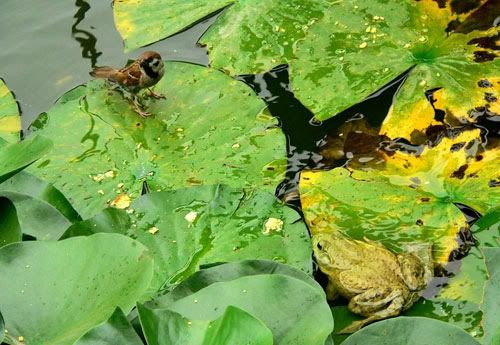
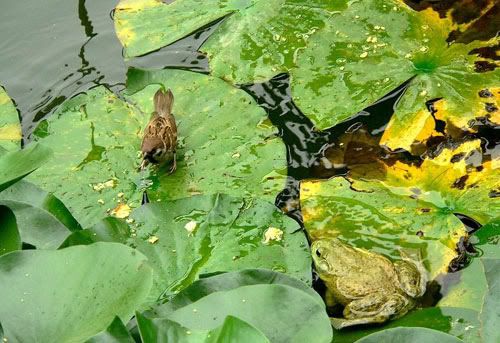
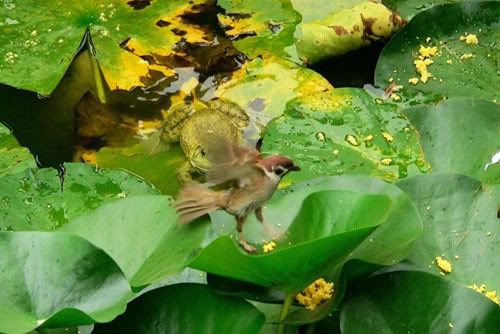
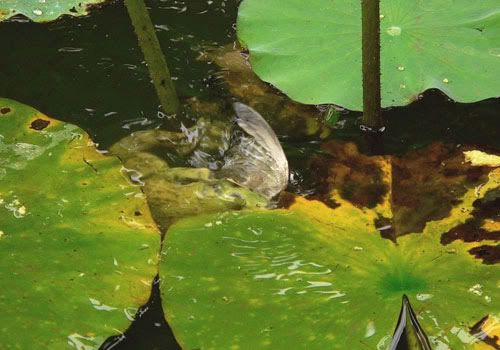
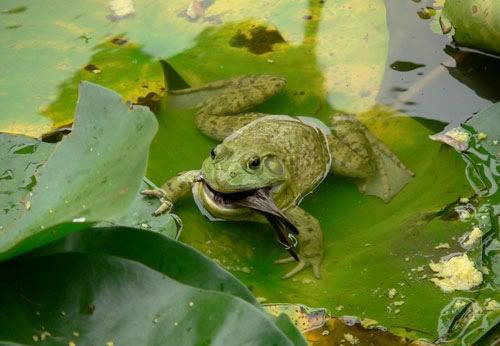
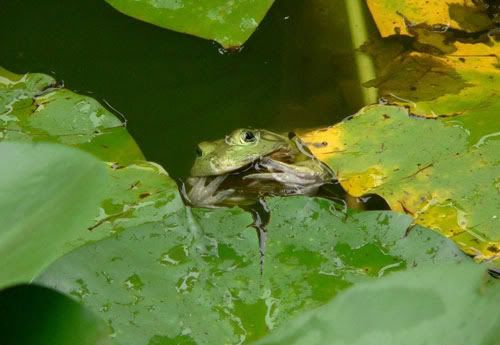


(photos via Cellar)

Wednesday, 24 September 2008

Tuesday, 16 September 2008

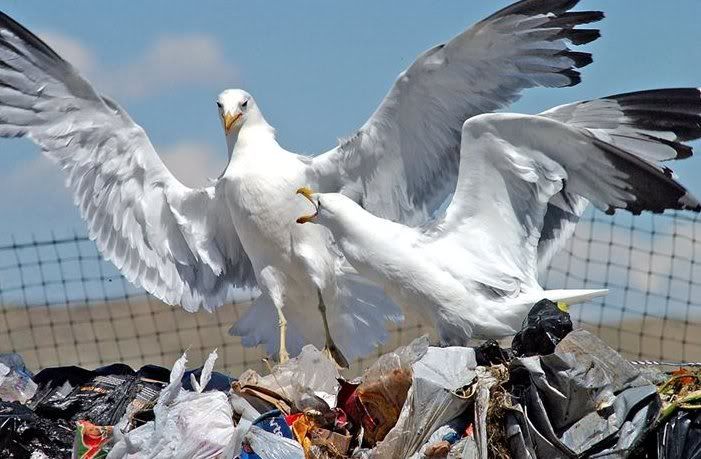
Hey, I was here first!


Photo: Jarrett Raffety / Rawlins Daily Times

Sunday, 7 September 2008

Takahashi Birds

Yoneguma and Kiyoka Takahashi were among many Japanese-Americans confined in Poston Camp, AZ after the bombing of Pearl Harbor.

While in the camp, they participated in a craft class where they learned to carve and paint small birds.

After their release from the camp, the Takahashis turned their craft into a family business that continued for 40 years.

Yoneguma carved the birds out of white holly wood, starting with a jig saw, then smoothing and sanding the bird. When done, Kiyoka painted the birds (using an Audubon bird book for reference) with watercolors using fine camel hair brushes. 10 coats of lacquer were then applied.

A good day's production was 10 birds. The birds were mostly sold via word of mouth, though a couple of department stores (such as Gump's) carried them. Production was mostly lapel pins, but earrings were also made. Price on the birds in the early days was $2, but in the 1980s, the birds sold for $40.

Initially more than 100 species were made, both male and female, but eventually about 25 different birds were offered regularly for sale.

The grand-daughter of Yoneguma and Kiyoka, Carol Takahashi, has created a website, Takahashi Birds, to honor her grandparents, tell their history, and to give us a glimpse of a time in history that affected many American lives.

(via Hanuman, also Image Event)

Saturday, 6 September 2008

Friday, 5 September 2008

Birds call brings police helpers

Cries for help inside a Trenton, N.J., home turned out to be for the birds. Neighbors called police Wednesday morning after hearing a woman's persistent cry of "Help me! Help me!" coming from a house. Officers arrived and when no one answered the door, they kicked it in to make a rescue.

But instead of a damsel in distress, officers found a caged cockatoo with a convincing call.

It wasn't the first time the 10-year-old bird named Luna said something that brought authorities to the home of owner Evelyn DeLeon.

About seven years ago, the bird cried like a baby for hours, leading to reports of a possible abandoned baby and a visit to the home by state child welfare workers. But it was only Luna practicing a newfound sound, DeLeon says.

Source: Yahoo news

Thursday, 4 September 2008

Here's my hummingbird ...

We've had a wonderful patch of bee balm planted in our backyard that has had hummingbird visitors for many years. As much as I try, I have yet to get a good photo - they are so QUICK!

Here's my latest (poor) attempts:


(You can click on the photos, go to Flickr, and see them larger)

These little birds are a delight. Even though we see several every day, it's still an occasion to stop what I'm doing and marvel at nature.

Hummingbird stories:
One day, I was sprinkling the flowers and a hummingbird repeatedly flew into and out of the water drops. She was taking a shower!

Hummingbirds are very territorial. When more than one arrive at the same flower bed at the same time, there's a very loud shrieking dispute until one backs off and leaves. We have seen the looser sit on a branch to wait her turn.

Just last week, we watched a hummingbird fly into a swarm of small gnats. She darted quickly from bug to bug, eating them. We've never seen that before! I thought all hummingbirds did was suck the nectar from flowers. This little bird caught so many bugs, she had to sit on the fence netting around the vegetables and rest. She sat there a good five minutes before she could fly. Talk about over eating!

Late summer brings hummingbirds to Illinois

August and September provide some of the year's best opportunities for observing hummingbirds in Illinois, according to Rob Kanter, author of The University of Illinois' Environmental Almanac. That's because individuals that have been farther north during the breeding season gather here on their way south.

Despite their small size, many hummingbirds migrate over long distances. Ruby-throats heading south may travel 2000 miles to reach their winter territory in southern Mexico and Central America, including a 500-mile nonstop leg of the trip over the Gulf of Mexico.

While the ruby-throated is the most common, rarer hummingbirds -- such as the broad-billed, Rufous and Allen's -- are seen across the Midwest from late summer into fall. The Rufous hummingbird is occasionally seen at feeders.

Source: abc7chicago.com

Wednesday, 3 September 2008

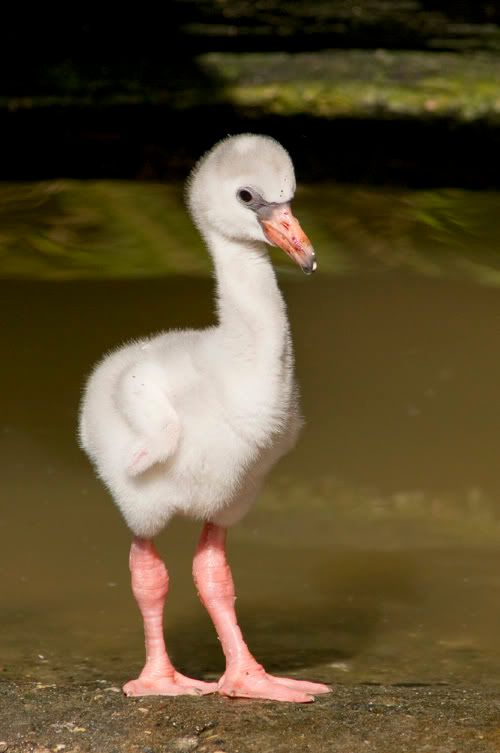
Two new greater flamingo chicks at the L.A. Zoo

The Los Angeles Zoo and Botanical Gardens is pleased to announce the hatching of two greater flamingo chicks, hatched on Tuesday, June 24 and Sunday, August 3. Both chicks are being reared by their parents in the lower walk-through aviary.

The greater flamingo is a social bird that breeds in colonies of tens to hundreds of thousands of birds in the wild. When they mate, they tend to pair for life. The male and female share duties when it comes to raising their chick. For example, they build the mud nest together, collectively care for the egg during the 28 – 32 day incubation period, take turns feeding the youngster and defending the nest.

Flamingos are hatched with grey color down feathers, short legs and a short, straight pink bill. They are fed a liquid secrection called “crop milk” until the chicks are fully developed. The flamingos’ pink and red plumage develops at about two years, with the feathers, legs and face coloration derived from the food found naturally in their diet of small shrimp, worms and algae. In zoos they are fed a special diet which helps them retain their color.

The greater flamingo is the largest of the six species of flamingo and has the widest of distribution. They are found in freshwater and saline habitats throughout southwest Europe, Africa, the Middle East, southwest Asia, India and Sri Lanka. Their exceptionally long neck and legs, and unique bill are adaptations for feeding. The flamingos plumage varies in color from almost white to bright pink with black primary and secondary flight feathers. They can fly long distances, up to 300 miles traveling mainly at night to find food. Flamingos like to rest and sleep standing on one leg, with the head laid on the body and the other leg tucked under the abdomen. What appears to be the flamingos knees are actually their ankles, which bend to the rear when they sit down. The greater flamingo is on display in the Zoo’s aviary with a variety of exotic bird species from around the world.

The Los Angeles Zoo and Botanical Gardens is located in Griffith Park at the junction of the Ventura (134) and Golden State (5) freeways. The Zoo is open from 10 a.m. to 5 p.m. daily. For general information, call (323) 644-4200 or visit the website at www.lazoo.org.

Photo credit: Tad Motoyama

Monday, 1 September 2008

Wednesday, 27 August 2008

Joke: Bi-Lingual Parrot

So this guy goes into a pet store and sees a beautiful parrot but it has a blue string handing from one foot and a red one from the other. He thinks this is a little strange so he asks the shopkeeper what the strings are for.

"Well this is a highly trained parrot" the shopkeeper replies. "If you pull the red string he talks in French, if you pull the blue string he talks in English".

"Wow" exclaims the man shopping that's really neat "What happens if you pull them both at the same time?"

"I fall off my perch you idiot!" exclaims the parrot.

(via)

Sunday, 24 August 2008

Take the bird with you

Easily transport your bird - to the veterinarian or the park - and keep him close, safe, and secure. Hands-free, vest-style bird carrier has padded shoulder straps and quick-clip waist strap for comfort. Durable mesh fabric allows good airflow and visibility for your bird. Zippered opening at top and bottom allows access. Removable bottom tray catches messes and wipes clean easily. Includes 1/2" diameter beveled perch and two toy hanging loops.

$29.99 at Doctors Foster and Smith

Monday, 4 August 2008

Friday, 25 July 2008

Poultry in Motion

Photo credit: Jodi Frazier / Parade Magazine

Tuesday, 22 July 2008

Lincoln Park Zoo has flamingo eggs

10 potentially viable eggs have been laid by Lincoln Park Zoo's Chilean flamingos, with zoo experts expecting offspring to begin hatching in about two weeks.
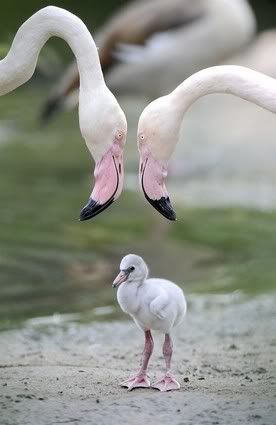
Available records indicate that the zoo has been egg-less since at least the late 1950s. In 2003, the zoo swapped breeds, changing from the American species to the hardier Chilean type. Adding the vegetation helped make the population -- there are currently 48 of the birds -- seem denser, which flamingos prefer.

Source: Chicago Sun-Times

FLAMINGO FACTS

Why are flamingos pink?
The color reflects the beta carotene in their diet of shrimp and shellfish.

Why do they stand on one foot?
Raising one foot helps them shift their weight to make themselves more comfortable. Folding one leg also can keep them warm by reducing the blood supply to the folded limb.

Do flamingos fly?
Yes, but they need a few paces to take off. Zoo flamingos either have their wings regularly clipped or are pinioned, having parts of their wings removed when they are young.

Source: Lincoln Park Zoo; Sea World

2nd photo: (via Mutts) Hanover Zoo's newest addition, who increases their flamingo family to an even 100 birds,

Monday, 21 July 2008

Hard to swallow?

An apparent set of conjoined twin birds -- an incredibly rare find -- has been discovered in Arkansas.


The bodies of the barn swallows, which are attached at the hip by skin and possibly muscle tissue, are being sent to the Smithsonian Institution for examination and confirmation, Arkansas wildlife officials said Friday.

The birds, found by a landowner in White County, fell out of a nest as a healthy sibling flew off to learn how to hunt with its parents, Rowe said. The birds first appeared to have only three legs, but further examination found a fourth leg tucked up underneath the skin connecting the pair.

Source: Boston.com

Tuesday, 15 July 2008

Three parrots

Three Parrots slide down the chutes..
(Just watch & wait ... )

Monday, 14 July 2008

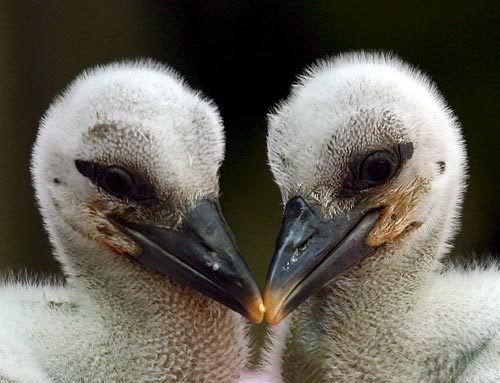
Cute or not? Stork chicks


Photo: Carsten Rehder/EPA

Tuesday, 8 July 2008

Jackson the macaw shows off

"Jackson the macaw shows off" by Critter Camp Mom

Critter Camp is the ONLY sanctuary in the U.S. actually which cares for such a large variety of different animals: Over 200 animals of 30 different species!