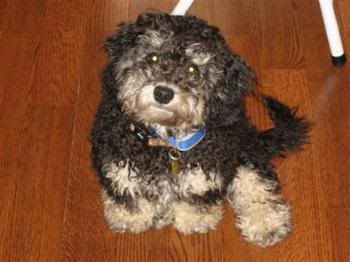
 He may not look fierce, but Pawlee, an 8-month-old cocker spaniel-poodle mix, scared off a mother bear and her two cubs who wandered into his owners' backyard in Wyckoff, N.J. The bears decided to vamoose when they heard Pawlee's furious barking.
Showing posts with label heroes. Show all posts
Showing posts with label heroes. Show all posts
Friday, 29 August 2008
A tough little guy
He may not look fierce, but Pawlee, an 8-month-old cocker spaniel-poodle mix, scared off a mother bear and her two cubs who wandered into his owners' backyard in Wyckoff, N.J. The bears decided to vamoose when they heard Pawlee's furious barking.

Tuesday, 26 August 2008
Fearless puppy scares off 3 bears in NJ back yard
 A 15-pound cocker spaniel-poodle mix named Pawlee scared off a mother bear and her two cubs Sunday morning after they strayed into his owners' back yard.
Whether his bark was worse than his bite, Pawlee's tactic worked just fine. These three bears got the hint and took off.
"We had just let him out for the morning and he ran into the yard and started barking his head off," owner Fran Osiason said.
Osiason said her 9-year-old son, Jacob, went outside to see what the commotion was about and came running back in to report there were bears in the yard.
She was worried that the mother would come after Pawlee to protect her cubs, but the pugnacious pup, just 8 months old, had other plans.
His barking drove the two cubs up a tree, and they eventually climbed down and hopped over a fence with their mother and retreated into the woods.
Source: AP
Monday, 25 August 2008
Dog Saves Abandoned Baby
 A newborn baby abandoned outdoors in winter by her 14-year-old mother was found safe in a dog pen with a mother dog and her brood of puppies near the city of La Plata.
The dog's owner, Fabio Anze, found the naked baby girl on Thursday, being kept warm among his dog China's puppies. Anze called the police and the baby was taken to a hospital.
Egidio Melia, director of the Melchor Romero hospital, told television and newspaper reporters that the baby was just a few hours old when she was found, and was in good health although she had some bruises.
Nighttime temperatures are chilly but not freezing in the Southern Hemisphere winter in the rural area around La Plata, 40 miles south of Buenos Aires.
Police said they had located the 14-year-old girl who gave birth to the baby outdoors during the night.
It was not clear whether the mother left her baby in the dog's pen or whether the dog found the baby outdoors and carried it in to join her puppies.
Source: Reuters
Thursday, 21 August 2008
An 'Angel' to the rescue
 Six orange tabby kittens were rescued because of the keen senses of Angel, a boxer/pit bull mix, who was recently surrendered to the Nevada Humane Society.
Frank Gomez and his 9-year-old stepson, Joel Fontes, have been regular volunteers at Nevada Humane Society this summer. The pair were volunteering on Monday, walking their favorite dog. Angel, a 2-year-old dog that came to the Humane Society's shelter after her owners moved without taking her along.
The walk was brisk, but was interrupted when Angel became obsessed with something in the bushes.
Gomez assumed it was Angel's inquisitive personality at play and didn't take it seriously.
But Angel refused to give up and Gomez discovered six 3-week-old orange tabby kittens in a box where they were abandoned.
Humane society staff were summoned, but not before one of the kittens escaped from the box. After returning to the scene, Angel led Gomez to the lost kitten, who picked her up and handed her over to safety.
(via L.A.Unleashed)
Thursday, 14 August 2008
Sirius, K-9 hero
 Police K9 Sirius was a bomb detection dog with the NY/NJ Port Authority Police Department. He and his partner, Police Officer David Lim, were assigned to the World Trade Center.
The morning of September 11, 2001, Sirius and Officer Lim were at their Port Authority Police Station in the basement of the World Trade Center's Tower Two. When Officer Lim heard the sound of an explosion, he thought a bomb had gone off inside the building, and he commented to Sirius, " ... one must have gotten by us."
Thinking he'd be more effective freehanded, Officer Lim left Sirius in his kennel telling him, "I'll be back to get you." as he rushed off to help with the rescue effort. At that time, he couldn't think of a safer place for his canine companion to be than in the basement while he was up doing the rescues.
Officer Lim didn't make it back though; he became trapped in the falling debris of Tower One and wasn't pulled out until more than five hours later. Sirius, however, perished in the tragedy, leaving Officer Lim without his faithful partner.
"He was very special," Officer Lim has been quoted as saying. "All dogs go home with us, so not only was he my partner, but he was also my pet and my friend." The bond between a K-9 and his master is special, and while David realizes the human tragedy will overshadow the death of his dog, he still misses Sirius. "We were very close; no matter where I went, he went. Whatever I asked him to do, he did. He never complained. Sometimes we'd be working for long hours, searching hundreds of cars or trucks, and he'd just look at me like, 'What do you want me to do now?' " Read more at Sirius' memorial page at Rainbow Bridge.
 Sirius was the only police dog to die in the collapse of the World Trade Center after the terrorist attacks on September 11, 2001. He was posthumously awarded the Victoria Cross by the British Embassy in Manhattan.
On April 24, 2002, more than 200 people and K-9 units from around the country gathered in Jersey City, NJ, at Liberty State Park, to pay tribute and to honor K-9 Sirius. In attendance were more than 100 police dogs and their partners. The service included a 21-gun salute, bagpipes, the reading of a poem by a school teacher from Illinois and plenty of barking.
Sirius is the only police dog to die in the Port Authority's 80-year history. Read more about the Memorial Service to Sirius.
 "Salute to Sirius"
© 2002 by
Debbie Stonebraker, Artist,
from Foley, Missouri
Privately commissioned by Sandee Nastasi of Long Island,
as a gift to the NY/NJ Port Authority Police Department K-9 Unit
P.O. Lim received a smaller water color version of the painting
Wednesday, 23 July 2008
the Dickin Medal
 The Dickin Medal was instituted in 1943 by Maria Dickin to honor the work of animals in war.
It is a large bronze medallion, bearing the words "For Gallantry" and "We Also Serve" within a laurel wreath, carried on ribbon of striped green, dark brown and pale blue. Traditionally, the medal is presented by the Lord Mayor of the City of London. It has become recognized as "the animals' Victoria Cross". As of February 2008, it has been awarded 62 times. (wiki)
The Medal, which can only be considered on receipt of an official recommendation, was awarded 54 times between 1943 and 1949. The recipients comprised 32 pigeons, 18 dogs, three horses and one cat.
In October 2000 a Canadian dog called Gander was added to the Roll of Honor. Since then, a further six Dickin Medals have been awarded and all to dogs.
 Tthe only cat to be awarded the Dickin Medal is Simon.
Awarded posthumously 1949, the record states that Simon “Served on HMS Amethyst during the Yangtze Incident, disposing of many rats though wounded by shell blast. Throughout the incident his behavior was of the highest order, although the blast was capable of making a hole over a foot in diameter in a steel plate.”
You can read the list of recipients at PDSA Dickin Medal: 'the animals' VC'. You can see more pictures of brave animals at BBC's World's Hero Pets.
Wednesday, 9 July 2008
Man rescues drowning bear
 It was a site you don't see everyday in the Panhandle in Florida. A man saved a bear from drowning last week. It all started after residents spotted a 375-pound black bear roaming through a neighborhood 40 miles south of Tallahassee. Officials with the Florida Fish and Wildlife Conservation Commission (FWC) found the bear underneath a beachfront home. They say it was probably trying to cool off. The goal was to lure it back into the wild.
So, officials used a tranquilizer dart on it. But, there was a problem. It did not work immediately. Biologist Adam Warwick, who struggled with the bear, said it tried to escaped and went into the Gulf of Mexico.
It was at that point Warwick said he could see the effects of the tranquilizer on the bear. He made a quick decision. Warwick went in after the animal.
The bear was about 25 yards from shore when it went into the water. Warwick said his adrenaline just kicked in. He didn't want the black bear to drown.
Source: Firstcoastnews
Thanks, Leslie!
Thursday, 29 May 2008
Special and unusual felines
We hear about famous and heroic dogs all the time; cats, not so often. I think it's because cats are not braggarts like dogs. Sure, there are many, many exemplary cats out there - they just shun publicity.
Here are the stories of some very unusual kitties:
 Oscar a.k.a. "Unsinkable Sam"
The black and white patched cat had been owned by an unknown crewman of the German battleship Bismarck. He was on board the ship on 18 May 1941 when it set sail on Operation Rheinübung, Bismarck's first and only mission.
Bismarck was sunk after a fierce sea-battle on 27 May, from which only 115 from its crew of over 2,200 survived. Hours later, the cat was found floating on a board and picked from the water, the only survivor to be rescued by the homeward-bound British destroyer HMS Cossack. Unaware of what his name had been on Bismarck, the crew of Cossack named their new mascot "Oscar".
About five months later, Cossack was hit and destroyed by a German submarine, and Oscar was again among the survivors.
The cat was then brought aboard the famous aircraft carrier HMS Ark Royal, but only three weeks later, this ship, too, was torpedoed by a submarine.
This luckily ended the cat's naval career. He was transferred first to the offices of the Governor in Gibraltar, and then sent back to the UK, where he saw out the remainder of the war living in a seamen's home in Belfast.
Sam died in 1955.
 Simon
Simon
Simon served on the Royal Navy sloop HMS Amethyst 1948 through November 1949.
Simon received the animal equivalent of the Victoria Cross for gallantry after he protected food stores on the HMS Amethyst from an infestation of rats, despite being badly injured in shelling by Chinese Communist forces during the country’s civil war.
He was later posthumously awarded the Dickin Medal for bravery, instituted in 1943 by Maria Dickin CBE, the founder of veterinary charity the PDSA, and was given the rank of "Able Seaman". Simon is the only cat among 62 animals to be awarded the Dickin Medal.
 Ms. Ruby LeGato
Ruby patrolled the Alamo in Texas from 1981 through 1985. Ruby was awarded a certificate of completion of the Basic Security Officer Training course from San Antonio College.
In 1988 Ruby was immortalized in Rita Kerr's book, "The Alamo Cat ". A bronze plaque marks her final resting place on the grounds of the Alamo.
 Fred
Fred
He came from the streets of Brooklyn, a cool customer on four legs, the perfect bait for a sting on a fake veterinarian. In February 2006, Fred was enlisted by the Brooklyn District Attorney’s office as an undercover secret agent, posing as a would-be patient to help the NYPD apprehend Steven Vassall, a Brooklyn man suspected of acting as a veterinarian without proper license or training.
On 18 May 2006, Fred was presented with a Law Enforcement Appreciation Award by Brooklyn district attorney Charles J. Hynes. Fred was later honored on July 8, 2006, at "Broadway Barks 8!", the New York City Theater District’s dog and cat adopt-a-thon benefit hosted by Mary Tyler Moore and Bernadette Peters. He was presented with the Mayor’s Alliance Award, which is given to remarkable animals.
Fred died on 10 August 2006 when he escaped from his home in Queens, New York and was struck and killed by a car. Fred was 15 months old.
 Tama
Tama
Because of budget cuts, the only stationmaster the Kishigawa Train Line in Japan can afford is Tama, a nine-year-old cat.
The railway company formally appointed her as "stationmaster" in January 2007. Happy with her successful job as stationmaster, the company promoted Tama to "super-stationmaster" in January this year, making her "the only female in a managerial position" in the company's 36-strong workforce. The company feeds her in lieu of salary.
 Wizzo
Wizzo
Fighting the war on rodent infestation, the 95th Mission Support Group is using a "military working cat" to help reduce the amount of damage to equipment caused by rodents living in the supply warehouse.
The cat, named Wizzo, calls the 95th Mission Support Group's supply warehouse his home. The feline lives and works around the clock as a mobility rodent deterrent.
So far, Wizzo has caught a bird, a rat and three mice, which officially makes him an ace. The supply team keeps his kill count posted on a board for him.
 Felix , or was it Félicette?
France launched a black and white stray tomcat of the Paris streets on October 18, 1963, on Veronique AGI sounding rocket No. 47 from the Hammaguir test range in Algeria. Was it a male named Felix. Or a female named Félicette?
Whichever, it was the first cat in space as the capsule in the rocket's nose cone separated at 120 miles altitude and descended by parachute. Electrodes in the cat's brain transmitted neurological impulses to a ground station. The cat was recovered.
Photo: Cats in simulated spacesuits [NASA archive]
Thanks to LA Unleashed for tips to the Ruby and Tama stories.
Here are the stories of some very unusual kitties:
Oscar a.k.a. "Unsinkable Sam"The black and white patched cat had been owned by an unknown crewman of the German battleship Bismarck. He was on board the ship on 18 May 1941 when it set sail on Operation Rheinübung, Bismarck's first and only mission.
Bismarck was sunk after a fierce sea-battle on 27 May, from which only 115 from its crew of over 2,200 survived. Hours later, the cat was found floating on a board and picked from the water, the only survivor to be rescued by the homeward-bound British destroyer HMS Cossack. Unaware of what his name had been on Bismarck, the crew of Cossack named their new mascot "Oscar".
About five months later, Cossack was hit and destroyed by a German submarine, and Oscar was again among the survivors.
The cat was then brought aboard the famous aircraft carrier HMS Ark Royal, but only three weeks later, this ship, too, was torpedoed by a submarine.
This luckily ended the cat's naval career. He was transferred first to the offices of the Governor in Gibraltar, and then sent back to the UK, where he saw out the remainder of the war living in a seamen's home in Belfast.
Sam died in 1955.
SimonSimon served on the Royal Navy sloop HMS Amethyst 1948 through November 1949.
Simon received the animal equivalent of the Victoria Cross for gallantry after he protected food stores on the HMS Amethyst from an infestation of rats, despite being badly injured in shelling by Chinese Communist forces during the country’s civil war.
He was later posthumously awarded the Dickin Medal for bravery, instituted in 1943 by Maria Dickin CBE, the founder of veterinary charity the PDSA, and was given the rank of "Able Seaman". Simon is the only cat among 62 animals to be awarded the Dickin Medal.
Ms. Ruby LeGatoRuby patrolled the Alamo in Texas from 1981 through 1985. Ruby was awarded a certificate of completion of the Basic Security Officer Training course from San Antonio College.
In 1988 Ruby was immortalized in Rita Kerr's book, "The Alamo Cat
". A bronze plaque marks her final resting place on the grounds of the Alamo.FredHe came from the streets of Brooklyn, a cool customer on four legs, the perfect bait for a sting on a fake veterinarian. In February 2006, Fred was enlisted by the Brooklyn District Attorney’s office as an undercover secret agent, posing as a would-be patient to help the NYPD apprehend Steven Vassall, a Brooklyn man suspected of acting as a veterinarian without proper license or training.
On 18 May 2006, Fred was presented with a Law Enforcement Appreciation Award by Brooklyn district attorney Charles J. Hynes. Fred was later honored on July 8, 2006, at "Broadway Barks 8!", the New York City Theater District’s dog and cat adopt-a-thon benefit hosted by Mary Tyler Moore and Bernadette Peters. He was presented with the Mayor’s Alliance Award, which is given to remarkable animals.
Fred died on 10 August 2006 when he escaped from his home in Queens, New York and was struck and killed by a car. Fred was 15 months old.
TamaBecause of budget cuts, the only stationmaster the Kishigawa Train Line in Japan can afford is Tama, a nine-year-old cat.
The railway company formally appointed her as "stationmaster" in January 2007. Happy with her successful job as stationmaster, the company promoted Tama to "super-stationmaster" in January this year, making her "the only female in a managerial position" in the company's 36-strong workforce. The company feeds her in lieu of salary.
WizzoFighting the war on rodent infestation, the 95th Mission Support Group is using a "military working cat" to help reduce the amount of damage to equipment caused by rodents living in the supply warehouse.
The cat, named Wizzo, calls the 95th Mission Support Group's supply warehouse his home. The feline lives and works around the clock as a mobility rodent deterrent.
So far, Wizzo has caught a bird, a rat and three mice, which officially makes him an ace. The supply team keeps his kill count posted on a board for him.
Felix , or was it Félicette?France launched a black and white stray tomcat of the Paris streets on October 18, 1963, on Veronique AGI sounding rocket No. 47 from the Hammaguir test range in Algeria. Was it a male named Felix. Or a female named Félicette?
Whichever, it was the first cat in space as the capsule in the rocket's nose cone separated at 120 miles altitude and descended by parachute. Electrodes in the cat's brain transmitted neurological impulses to a ground station. The cat was recovered.
Photo: Cats in simulated spacesuits [NASA archive]
Thanks to LA Unleashed for tips to the Ruby and Tama stories.
Friday, 16 May 2008
What a dog!
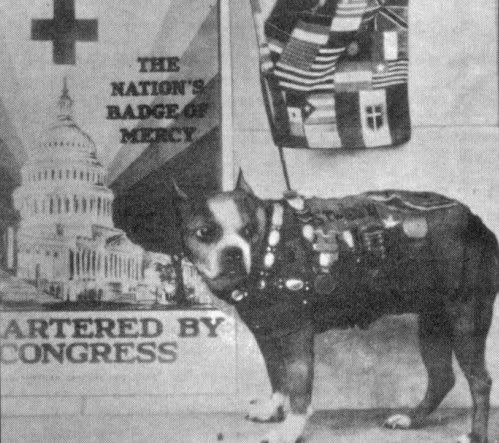 Sergeant Stubby, a Bull Terrier mix, is the single most decorated dog in U.S. history.
He was picked up as a stray in 1917, by Private J. Robert Conroy when the homeless dog appeared at the training camp of the 102nd Infantry at Yale University. Conroy and buddies kept Stubby with them through all their drills and training and, in July 1917, when it came time to ship out for France, they smuggled Stubby aboard ship.
Within weeks of their arrival in the European theatre, the 102nd was under fire on the front lines in France. The boom of artillery fire didn't faze Stubby in the least, and the men learned of incoming bombs by watching him. Stubby could hear the whine of shells long before the men.
For 18 months Stubby carried messages under fire, stood sentry duty, and helped paramedics find the wounded in “no man’s land”. He gave early warning of deadly gas attacks and was credited many times with saving his entire regiment. When Stubby found and helped capture a German spy who was mapping a layout of the Allied trenches, he was awarded the honorary rank of Sergeant - the first dog to be given rank in the U.S. Armed Forces. When seriously wounded by shrapnel, he was sent to the Red Cross hospital for surgery just like any other soldier. Once recovered, Stubby returned to his regiment and continued to serve until November 11, 1918, the day the war ended.
Named a life member of the Red Cross and the American Legion, Stubby was awarded many medals including one by General John J. Pershing. Called to the White House several times to meet Presidents Harding and Coolidge, he led more regimental parades than any other dog in history.
Stubby spent his final years with John Conroy, the soldier who had rescued him so many years ago. He died of old age in 1926. Stubby's remains were preserved with technical assistance from the Smithsonian Institution. Stubby, his medals and personal effects were donated to the Smithsonian by Conroy and can still be seen there.
Subscribe to:
Posts (Atom)
Subscribe To


 Posts
All Comments
Posts
All Comments
