Showing posts with label wildlife. Show all posts
Friday, 5 September 2008
California Wildlife
While vacationing in California, I was always on the lookout for wildlife (click on photos to enlarge):
17 Mile Drive, Pebble Beach, winds through a lush forest and along a rocky coastline. How wonderful it must be to live here. We stopped at Bird Rock, home to sea lions and ... well, lots and lots of birds.
A sign along 17 Mile Drive advises visitors not to feed the animals, but this squirrel looks like he does all right.
In Muir Woods, a deer ventured close to the trail for a drink. Like a pack of hungry paparazzi, tourists snapped at the bit of fur visible through the leaves.
Sea lions or seals? I'm not sure, but these guys in San Francisco are a noisy, comic bunch.
Question: We wondered why is the rock along the coast is white? Is it bird poop? I'm not quite sure what that speck is in the middle of the photo -- a bee, a helicopter, Superman?
Thursday, 31 July 2008
Bears on the attack in Russia
Today, however, Russia’s bears are on the attack.
Some thirty gigantic and ravenously hungry Kamchatka brown bears have already killed and eaten two men at a platinum mine in Russia’s Far Eastern Kamchatka region and appear to be hunting for more. People in the region have been forced to cower in their homes waiting for hunters to dispose of the animals, which can stand 10 feet tall and weigh up to 1,500 pounds.
The bears are generally peaceful and feed on salmon in Kamchatka's rivers. Environmentalists argue that widespread poaching has caused a fish shortage, prompting the starving bears to become aggressive as they seek out food close to human settlements.
Source: New York Times
Monday, 14 July 2008
Wild China

Wild China is a six-part BBC documentary on the people, wildlife and history of China. Here in Canada, the series is being shown on CBC's The Nature of Things, and is narrated by David Suzuki.
Apparently, the biggest problem the producers had was trying to find wildlife to film. But over 16 months and many miles, they succeeded in putting together a fascinating series. Highly recommended.
Of course, it's the Olympics that made the entire production possible -- the BBC was given unprecedented access to remote areas within China. And we can also thank the upcoming Games for the recent Chinese government ban on selling dog meat in restaurants.
Friday, 11 July 2008
Get Close to the World’s Deadliest Animals
Photo: Tut99 (Roger)
Wednesday, 9 July 2008
Man rescues drowning bear
So, officials used a tranquilizer dart on it. But, there was a problem. It did not work immediately. Biologist Adam Warwick, who struggled with the bear, said it tried to escaped and went into the Gulf of Mexico.
It was at that point Warwick said he could see the effects of the tranquilizer on the bear. He made a quick decision. Warwick went in after the animal.
The bear was about 25 yards from shore when it went into the water. Warwick said his adrenaline just kicked in. He didn't want the black bear to drown.
Source: Firstcoastnews
Thanks, Leslie!
Wednesday, 2 July 2008
Canadian Loonies and Toonies

Yesterday, July 1st, was Canada Day, celebrated with parades, fireworks, the whole shebang. Canada is only 141 years old -- still a baby compared to our cousins across the pond. Anyway, I thought I'd share a few money facts about this great country:
The beaver is our national animal, and is featured on the back of our nickel. The animal's importance to this country stems from the value of its pelt when Canada was first explored.
The loon is featured on the Loonie, our dollar coin that's been in circulation for about 20 years. There is nothing quite as lonely as the sound of this water bird when you're sitting by a lake up north. Apparently, the loon mates for life. I like a bird that can make a commitment.
On our two dollar coin, the Toonie, there's a picture of a polar bear. I just hope these magnificent animals can survive global warming and all the other crap people have thrown at the Earth.
And yes, "Loonie" and "Toonie" are the official names of the coins. Only in Canada, eh?
Friday, 20 June 2008
Alligator found in Chicago River
The alligator, which is about 5 1/2 to 6 feet long, was found near 37th Street and the Chicago River about 2:15 p.m. by a citizen who called police.
The city’s department of Animal Care & Control, 2741 S. Western Ave., took the alligator, which was alive, and no injuries were reported.
Source: Chicago SunTimes
Fate of the Animals
The History Channel's documentary, "Life After People", gives viewers an idea of what might happen to our world if humans suddenly disappeared -- forever. I find this sort of thing fascinating, so much so that I based my fantasy books Key to Aten and Return to Aten on just such a premise. Of course, in my books, some humans did survive -- the reading would have been terribly dull without a few people sprinkled about.
Back to the documentary:
If you get a chance, do watch it. It's a bit frightening to discover how nature would cover up all traces of our existence, and interesting to know the fate of the animals.
Saturday, 14 June 2008
What People Want
It's interesting and helpful to know what brings people to my blog, so occasionally I check the search terms readers use. By far, the most common inquiry is "how to get rid of stray cats". That search will take them here and here (Note: the second link is far more useful). I had no idea there were that many unwanted cats in the world. The worst search string is "how to poison feral/stray cats". It's so upsetting to know that people are actually considering this option. I do not, under any circumstances, condone poisoning an animal. Disheartening as it is to discover that people are looking for ways to kill an animal, I'm happy to report that many folks are looking for ways to help sick pets, feed bunnies living in their backyards, or ideas on how to keep their pets entertained.
A few other memorable searches:
"What to do when dog eats thong"
I have no idea. In fact, I can't recall ever using the word 'thong' in my blog.
"Wearing fur for bugs"
???
"Alcoholic names for pets"
This is searched quite often, so don't be surprised if you meet a Chocolate Martini or Bloody Mary next time you visit the dog park.
I hope that no matter what brings readers here, they will return to share some of their own stories and comments.
Update July 8, 2008: Yesterday, someone discovered my site with the search "is rabbit safe to eat from the backyard". I wouldn't recommend it. I don't think the rabbit would either.
Sunday, 8 June 2008
This is What Happens When You Let Your Mind Wander

I'd always been curious as to why zebras hadn't been domesticated. Other than the jail house duds, they look pretty much like horses, so wouldn't it be handy to saddle one up before making the long trek across the African plains?
After a bit of research, I've discovered that zebras are near-impossible to tame, and their body shapes are different from horses, making them difficult to fit a saddle. I kind of like the fact that zebras have successfully maintained their freedom.
On the other hand, why did anyone even consider domesticating a Madagascar hissing cockroach? They can grow to three inches long, are wingless, live up to three years, and make great pets for young children. I just can't imagine bringing a cockroach into my home.
As pets or tools (and let's face it, we do use them), animals play important roles in our lives. And yet, many people continue to abuse them. Do you think they'll revolt one day, take over the world before we completely screw it up?
Monday, 2 June 2008
Animal Myths
In my last post about composting, Raggs wondered if it was true that a worm would survive being cut in half (apparently not). That got me thinking about other animal myths.
Frightened ostriches bury their heads in the sand
Not true. This myth may have started because, from a distance, it's difficult to see their tiny heads as they peck at the dirt.
Touching toads will give you warts
Although the toads may have bumps, touching them will not cause a breakout of warts. This reminds me of two things:
1) When my mom was a little girl, she was told if she buried a cut potato in her yard, her wart would disappear. Amazingly, this advice turned out to be false.
2) If you get the opportunity, watch the hilarious Australian "documentary" Cane Toads: An Unnatural History. It details, in comedic fashion, what can happen when an unnatural animal is introduced into a new environment.
Bats are blind
Strike "blind as a bat" from your vocabulary -- not only do bats have exceptional hearing, they can also see.
Black cats bring bad luck
I have no idea how this superstition began, but I do know that my local pet adoption centre won't sell any black cats in the weeks preceding Halloween. I don't even like to think of the reasons why they have to take this precaution.
By the way, that's a picture of my cat, Meeko.
Thursday, 29 May 2008
Compost Condo
I like my compost bin. I'm amazed by the magic that turns garden clippings and vegetable scraps into rich compost. But a few years ago, things didn't go according to plan.
It was early summer, and each time I removed the lid of the bin, the mound of compost moved ever so slightly. It was like a tiny earthquake that immediately settled. By mid-summer, I heard them, and soon after, saw them. A mouse and her babies had set up house in my bin. I couldn't blame them -- the compost provided food (replenished almost daily), warmth, safety, and a great view of the garden (pictured). Knowing the mice were there, I was afraid to tun the compost with a fork or shovel, fearing I'd injure one of them. I left the door at the bottom of the bin open about an inch, but they seemed to use it only for quick day trips, never taking the hint that I'd served them an eviction notice.
I decided to bodily remove the mice on Labour Day weekend because when I opened the lid, five well-fed mice jumped madly on top of the pile of compost. Perhaps the heap had become too hot, or their tunnels had collapsed and they were unable to escape. Whatever the problem, they appeared to be going nuts.
I grabbed my daughter's flimsy, dollar store butterfly net, and a bucket with a lid. Drawing a deep breath, I scooped the critters out of the bin, one at a time. I was successful in getting four of them into the bucket, but the fifth jumped out and ran into my neighbour's backyard (I hope they don't read this blog). With a parade of kids following me, I carried the bucket into the forest across the street, and deposited the mice deep in a grove of trees. I didn't have much hope for their continued survival -- after all, they'd never had to forage for a meal in the short lives.
Last year, a mole set up home in the compost bin. I spotted his funny, little nose poking out from a tunnel near the bottom of the bin. I don't think he stayed long because I never saw him again. I do have a lot of worms in my bin. When it rains, they all congregate under the rim of the lid, and I'm always afraid that I'll squish them if I put the lid back on. I don't like touching worms, so using a twig, I gingerly place them back into the bin. Although now that I think about it, they may be trying to escape, and I've just thrown them back into their compost jail.
Ah, wildlife. Yes, I have rabbits and birds visiting my yard regularly, but it's really the compost bin where all the action takes place.
Wednesday, 21 May 2008
Lions and Tigers and Bears ... Okay, just one tiger
In 2001, my daughter and I were driving home through our neighbourhood when we spotted this orange, white and black ball of fluff on the sidewalk. I couldn't believe our luck -- a Siberian tiger cub, and we weren't even at the zoo! Most importantly, we got to pet him (and you can tell by my smile that I'm absolutely thrilled):
The man walking the cub told us he'd brought it home from the wildlife sanctuary where he volunteered because there was no one there to care for it that weekend. The tiger will have grown up by now, and I don't imagine he'd let me rub his stomach. Shame.
Tuesday, 20 May 2008
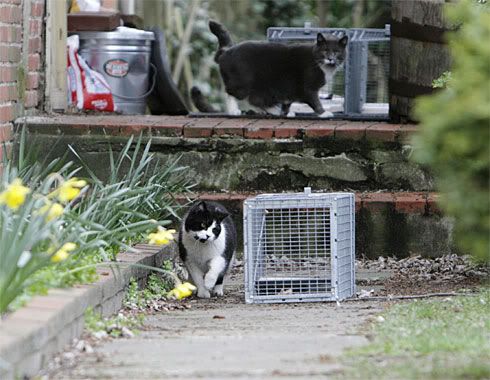
Compassion for feral cats
Feral cats — nearly invisible and often reviled — have prowled into the spotlight.
The free-roamers with an aversion to humans have grabbed headlines this spring because of a bounty on their heads in Iowa, a threatened roundup and disposal in Fairfax County, Va., and other elimination plans across the country.
But the cats also are receiving attention of a different sort.
Grass-roots groups and animal-welfare organizations are directing money and energy toward helping the tens of millions of feral cats that skulk about college campuses, cluster around back-alley trash bins, swarm among the rocks at beach communities and colonize the nether-reaches of suburban parks, military installations and abandoned barns and fields.
According to Neighborhood Cats, a "feral" cat is one who has reverted in some degree to a wild state. They originate from former domestic cats who were lost or abandoned and then learned to live outdoors or in environments involving little human contact.
TNR (trap/neuter/return) respects a feral cat's wild state. The neutering of the ferals prevents tremendous suffering and shields the cats from the hostility their behavior might otherwise draw from human neighbors. But the return of them to their own territory and the providing of adequate food and shelter gives them the opportunity to live among their own, to be free and to answer to their own unique natures.
This method thwarts future litters and reduces the yowling, spraying and fighting that annoy humans. In the process, the cats usually are vaccinated, treated for minor problems and given a notch in the ear to identify they are sterile. Over time, the colony will grow smaller through attrition.
For a list of organizations with programs to benefit feral cats, see the USA Today article, Compassion often eludes feral cats; groups out to save them, by Sharon L. Peters.
Photo: Joan Fairman Kanes for USA TODAY
But the cats also are receiving attention of a different sort.
Grass-roots groups and animal-welfare organizations are directing money and energy toward helping the tens of millions of feral cats that skulk about college campuses, cluster around back-alley trash bins, swarm among the rocks at beach communities and colonize the nether-reaches of suburban parks, military installations and abandoned barns and fields.
According to Neighborhood Cats, a "feral" cat is one who has reverted in some degree to a wild state. They originate from former domestic cats who were lost or abandoned and then learned to live outdoors or in environments involving little human contact.
TNR (trap/neuter/return) respects a feral cat's wild state. The neutering of the ferals prevents tremendous suffering and shields the cats from the hostility their behavior might otherwise draw from human neighbors. But the return of them to their own territory and the providing of adequate food and shelter gives them the opportunity to live among their own, to be free and to answer to their own unique natures.
This method thwarts future litters and reduces the yowling, spraying and fighting that annoy humans. In the process, the cats usually are vaccinated, treated for minor problems and given a notch in the ear to identify they are sterile. Over time, the colony will grow smaller through attrition.
For a list of organizations with programs to benefit feral cats, see the USA Today article, Compassion often eludes feral cats; groups out to save them, by Sharon L. Peters.
Photo: Joan Fairman Kanes for USA TODAY
Wednesday, 14 May 2008
Great tits cope well with warming
The great tits are laying eggs now about two weeks earlier in the year than they were 47 years ago.
The timing is crucial, because for the two-week period after they hatch, the chicks have to gobble down huge quantities of winter moth caterpillars which only emerge for a short period.
via Presurfer
Is that a squirrel in your pocket ... ?
The City Birder has a cute post about encountering a cute, little, cold, young, squirrel who wanted to make friends.

And here's another tale about a rescued baby squirrel, complete with YouTube video:
Sunday, 11 May 2008
Furry and Feathered Moms
Friday, 2 May 2008
Online Roadkill Registry
So the Wilson family initiated roadkill hikes, looking for and cataloging the many fallen animals along the roadsides in their own record book.
What began as a family pass time for the Wilsons is now a national book of registry paying tribute to the deer, bears, raccoons, fox, crows, coyotes, pheasants and other animals that have met their maker on the nation’s highways.
You, too, can register your roadkill discoveries at the Road Kill Record Book Club. Download a form for $10.00, and start watching those road sides!
(via newshound)
Tuesday, 29 April 2008
Okefenokee Swamp gator to live on in display
But sometime during his long life, someone must have wanted his hide.
Oscar survived a shotgun blast to the face, at least three bullet wounds to the head, turf wars, multiple broken bones and crippling arthritis. Officials know that now because the beloved old gator died last July and the evidence is visible in his bones.
Source: Jacksonville.com
Feds sued for taking gray wolves off endangered list
Wolves in 1974 almost disappeared as a species in 48 US states -- excluding Alaska and Hawaii -- except for some isolated packs in Minnesota and Michigan.
In 1995, 66 wolves were released by the government in Idaho and in the nearby Yellowstone National Park with the hope they would propagate and multiply.
The program was successful. Currently, an estimated 1,200 wolves roam Idaho, Montana and Wyoming.
But now, the U.S. Fish and Wildlife Service has removed the region’s 1,500 wolves from the endangered list in March, turning over management responsibilities to state officials in Idaho, Wyoming and Montana.
Defenders of Wildlife said in a statement that Wyoming and Idaho authorities had given their residents a blank check for the "senseless and indiscriminate killing of wolves."
Source: CANOE
Subscribe to:
Posts (Atom)