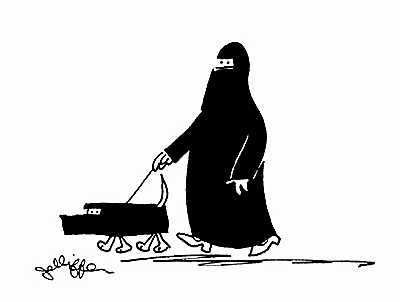
Saudi Arabia's religious police have announced a ban on selling cats and dogs as pets, or walking them in public in the Saudi capital, because of men using them as a means of making passes at women, an official said on Wednesday.
Othman al-Othman, head of the Commission for the Promotion of Virtue and the Prevention of Vice in Riyadh, known as the Muttawa, told the Saudi edition of al-Hayat daily that the commission has started enforcing an old religious edict.
The reason behind reinforcing the edict now was a rising fashion among some men using pets in public "to make passes on women and disturb families," he said, without giving more details.
The 5,000-strong religious police oversees the adherence to Wahabism -- a strict version of Sunni Islam, which also forces women to cover from head to toe when in public, and bans them from driving.
In the 1968 science fiction film, Planet of the Apes, an astronaut believes he has landed on another planet, one on which the humans have no language, but the great apes do. As the movie ends, the astronaut realizes that he has been on Earth all along, and that humanity must have destroyed its own civilization with war, thereby paving the way for the Planet of the Apes.
I can't help but flash onto scenes from this movie - animals are in power, animals have rights, but people don't - when I read about recent laws enacted by Spain's parliament.
Spain's parliamentary environmental committee approved resolutions urging Spain to comply with the Great Apes Project, devised by scientists and philosophers who say our closest genetic relatives deserve rights hitherto limited to humans.
The Spanish government is now committed to update the statute book within a year to outlaw harmful experiments on apes in Spain. Keeping apes for circuses, television commercials or filming will also be forbidden.
Philosophers Peter Singer and Paola Cavalieri founded the Great Ape Project in 1993, arguing that "non-human hominids" like chimpanzees, gorillas, orang-utans and bonobos should enjoy the right to life, freedom and not to be tortured.
As an avid traveler, I've seen dogs in cafes and restaurants in many locations around the world. Just about anywhere but Chicago, it's totally acceptable to bring your dog out with you for breakfast, lunch, or dinner. In Paris, I've seen dogs indoors, sitting right at the table, eating off a plate!
In Chicago, as of January 1, 2008, state law allows for dogs in restaurants, provided that the restaurant obtains license approval, registration, and posts a notice that dogs are allowed. But according to a recent article in Crain's Chicago Business, "Taking Names: Gibsons, RL don't jump to allow dogs," some local eateries seem to be dragging their feet.
The city says there's no wait time — presuming a restaurant has no debt and there are no administrative issues — to receive the $450 dog-friendly license, so why isn't every Chicago restaurant with an outdoor eating area licensed already? Our nice weather season is so short!
Starbucks in San Diego, CA.
Restaurant sidewalk cafe in Nürnberg, Germany.
Outdoor restaurant, Szentendre, Hungary.
Starbucks outside of the Long Wharf Marriot, in Boston, MA.
The Prado restaurant in Balboa Park, San Diego, CA.
The Associated Pressreports that the Dutch government will lift a long-standing, 15-year long ban on pit bulls because it did not lead to any decrease in bite incidents.
Instead, the country will focus on enforcing local leashing laws and owner education programs.
Ohio House Bill 568, introduced by Representative Tyrone Yates of Cincinnati, seeks to prohibit the ownership, keeping, or harboring of a dog that "belongs to a breed that is commonly known as a pit bull dog."
If this bill is passed and adopted into law, all pit bulls in Ohio will be seized and euthanized.
HB 568 provides that:
* No person shall own, keep, or harbor a dog that belongs to a breed that is commonly known as a pit bull dog.
* No later than 90 days after the effective date of this bill, a person who owns, keeps, or harbors a pit bull dog will be forced to surrender the dog to a dog warden.
* Within ten days of surrender, the dog warden shall euthanize the dog.
* If an officer has probable cause to believe that a dog is a pit bull, the officer may apply for a search warrant. After obtaining a search warrant, an officer shall seize the dog and transfer the dog to the dog warden, who shall euthanize the dog within 10 days.
It is imperative that all concerned dog owners in Ohio contact the elected representatives and express their vehement opposition to this draconian legislation.
All concerned Ohio dog owners should contact their elected representatives and express their strong opposition to HB 568. To find your elected representatives, click here.
The small town of Osceola, NE is considering a breed ban that would ban American Pit Bull Terriers. The town has exactly one APBT, who has never caused any problems whatsoever and has no complaints registered against her.
Maggie, the only pit bull in town, lives across the street from Renee and Kent Johansen and their three children. The Johansens are leading the move for the ban. The Johansens, say they are concerned about the safety of their young children living in such close proximity to the pit bull.
“I know that specific dog has not done anything yet,” Renee Johansen said in a phone interview.
Maggie's owners, however, have purchased a $100,000 liability insurance policy, a stake that could not be pulled out of the ground, shortened her chain, got her a muzzle and the signs that were needed. They're trying to find a picture sign that warns about dogs for kids who can’t read.
The Osceola council says it wants to do the right thing and not make a law that squarely impacts one person, so they are banning 7 breeds of dogs: Staffordshire Bull Terrier, American Pit Bull Terrier, Am. Staffordshire Terrier, Chows, Dobermans, Rottweiler, American Bandage Mastiff, Neopolitan Mastiff, and any dog with the appearance of any of the above. American Bandage Mastiff? Just in case there is one, somewhere in the world.
Authorities in Swaziland have declared war on roosters in the capital city because the birds are disrupting people's sleep. Authorities are set to enforce a 40-year-old law that permits residents to raise up to 12 chickens with permission but no roosters.
(Here's the quote of the week - ready?)
"After many instances we have found cocks to be troublesome and they end up making lives miserable for residents," said a Mbabane Municipal spokesman.