Showing posts with label apes. Show all posts
Thursday, 28 August 2008
Family photos
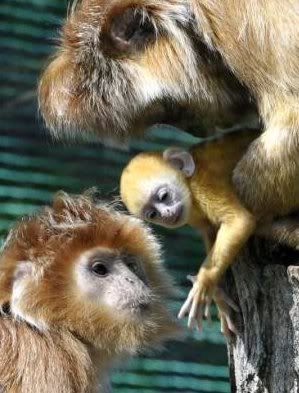
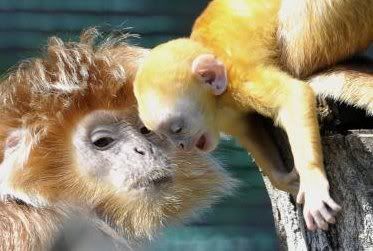
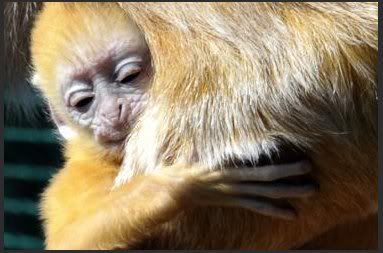
This happy family is father - Orange, mother - Smirre, and their one-week old baby, who live at the Budapest Zoo Park and Botanic Garden. They are Javan Lutung (Trachypithecus auratus) also known as Javan Langur. The cub was born on August 18, 2008.
Monday, 18 August 2008
Wednesday, 9 July 2008
Making way for the Planet of the Apes
I can't help but flash onto scenes from this movie - animals are in power, animals have rights, but people don't - when I read about recent laws enacted by Spain's parliament.
Spain's parliamentary environmental committee approved resolutions urging Spain to comply with the Great Apes Project, devised by scientists and philosophers who say our closest genetic relatives deserve rights hitherto limited to humans.
The Spanish government is now committed to update the statute book within a year to outlaw harmful experiments on apes in Spain. Keeping apes for circuses, television commercials or filming will also be forbidden.
Philosophers Peter Singer and Paola Cavalieri founded the Great Ape Project in 1993, arguing that "non-human hominids" like chimpanzees, gorillas, orang-utans and bonobos should enjoy the right to life, freedom and not to be tortured.
Next, we'll be teaching them to talk.
Monday, 7 July 2008
Cute or not? Baby white-naped mangabey
Conchita was born at the London Zoo in April, 2008.
Monday, 16 June 2008
Monday, 26 May 2008
Video: Borneo Apes - Malaysia
By some estimates, Borneo's vast forests are being cleared faster than the Amazon. Unless something is done now, Orangutans could be extinct in 20 years.
The practice of bulldozing everything to make way for palm oil plantations has left Orang-utans without their customary habitat.
Lone Droescher-Nieslen from the Orangutan Survival Foundation hopes she can rehabilitate the Orangutans back into the wild. But if the rate of deforestation continues, there may soon be no forests to release them into...
Watch the video
The practice of bulldozing everything to make way for palm oil plantations has left Orang-utans without their customary habitat.
Lone Droescher-Nieslen from the Orangutan Survival Foundation hopes she can rehabilitate the Orangutans back into the wild. But if the rate of deforestation continues, there may soon be no forests to release them into...
Watch the video
Thursday, 22 May 2008
White-handed Gibbons Now Presumed Extinct
Science Daily reports that the 14-member scientific team recently carried out a survey in all Chinese forests. They could not locate a single Yunnan white-handed gibbon. The last time this ape was observed in China was in 1988 at the Nangunhe Nature Reserve in south-western Yunnan province. Their loud, melodious calls were last heard in 1992. This subspecies (Hylobates lar yunnanensis) is not known from any other place.
Luckily, these apes are not lost to us forever. Several zoos have included them in their programs. One is the Honolulu Zoo. On their web page, you can hear the call of the white-handed gibbon:
listen
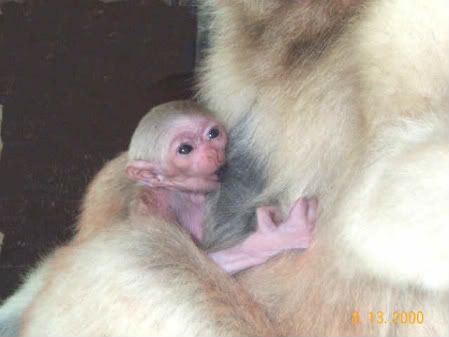
You can also see pictures of Emma, an adorable baby white-handed gibbon, born in 2000. Here's a picture of Emma, 7 hours after birth.
Monday, 19 May 2008
Thursday, 15 May 2008
Jenny's birthday
This is Jenny. Jenny is recognized as the world's oldest gorilla in captivity
Gorillas in the wild normally would live to age 30 or 35, but health care and protection from predators has extended their lifespan in zoos. Of the roughly 360 gorillas in North American zoos, only four are over the age of 50. All of them are female. Jenny is the oldest of them all at 55.
Caretakers at the Dallas Zoo, where Jenny lives, celebrated her birthday with a four-layer frozen fruit cake and banana leaf wrapped treats.
Source: Live Science
Caretakers at the Dallas Zoo, where Jenny lives, celebrated her birthday with a four-layer frozen fruit cake and banana leaf wrapped treats.
Source: Live Science
Tuesday, 13 May 2008
Care for Apes
What happens to performing primates once they're past their prime? The lucky ones end up in facilities like the Center for Great Apes in Wauchula, FL.
Brenda Scott Royce, in the Huffington Post, writes,
Currently, the Center houses forty-three apes, fourteen orangutans and twenty-nine chimpanzees, ranging in age from one to forty-six years. These great apes live in enriching environments and habitats, provided with proper nutrition and companionship and with their own species. They live in large 34-foot tall outdoor habitats with lots of climbing apparatus, swings, and enrichment toys. They sleep in attached heated nighthouses strong enough to withstand Florida hurricanes. The sanctuary is located in South Central Florida on 100 wooded acres surrounded by orange groves.
Pebbles is one of the Center for Great Apes current residents. She arrived at the Center in December 2004 from a California trainer compound where she was worked as an infant in the entertainment business. She still had a few years of working ability ahead of her, but her owner decided to stop working great apes in shows and commercials.
Pebbles loves to swing on vines in her enclosure, play in tubs of water, and wrestle with her orangutan roommates. One of her favorite enrichment activities is painting. Not only will she paint on paper or canvas given to her, Pebbles also enjoys covering herself with nontoxic paint!
via L.A. Unleashed
Brenda Scott Royce, in the Huffington Post, writes,
" Apes in showbiz have a short shelf life.The primary purpose of the Center for Great Apes is to provide a permanent sanctuary in a safe and enriching environment for orangutans and chimpanzees in need of long-term life care … specifically those who have been used in entertainment, kept as pets by private owners, or served as research subjects.
The average performing chimp begins his career around age 2. By 7 or 8, when he's no longer the tractable trainee he once was, he's put out to pasture.
Owners tend to not want to keep apes that have outlived their earning potential, and since apes can live into their 50s, that means they'll require decades of care after their careers end. And that care is expensive -- roughly $10,000 a year for a single ape. And while typically everyone involved with a film -- from cast and crew to producers, studios, distributors, investors and exhibitors -- makes money, nothing is put aside for the animals' future. "
Currently, the Center houses forty-three apes, fourteen orangutans and twenty-nine chimpanzees, ranging in age from one to forty-six years. These great apes live in enriching environments and habitats, provided with proper nutrition and companionship and with their own species. They live in large 34-foot tall outdoor habitats with lots of climbing apparatus, swings, and enrichment toys. They sleep in attached heated nighthouses strong enough to withstand Florida hurricanes. The sanctuary is located in South Central Florida on 100 wooded acres surrounded by orange groves.
Pebbles loves to swing on vines in her enclosure, play in tubs of water, and wrestle with her orangutan roommates. One of her favorite enrichment activities is painting. Not only will she paint on paper or canvas given to her, Pebbles also enjoys covering herself with nontoxic paint!
via L.A. Unleashed
Tuesday, 8 April 2008
Heart disease hits zoo gorillas
Gorillas in zoos around the nation, particularly males and those in their 20s and 30s, have been falling ill - and sometimes dying suddenly - of heart disease.
The stunning deaths of otherwise healthy apes have zookeepers scrambling to understand what factors may be causing the illnesses and what might be done to save the 368 lowland gorillas that now reside in 52 zoos across North America.
Ape experts have established the Gorilla Health Project, looking to track rates of heart disease and death among gorillas in captivity.
Read the excellent article at Monkeys in the News.
The stunning deaths of otherwise healthy apes have zookeepers scrambling to understand what factors may be causing the illnesses and what might be done to save the 368 lowland gorillas that now reside in 52 zoos across North America.
Ape experts have established the Gorilla Health Project, looking to track rates of heart disease and death among gorillas in captivity.
Read the excellent article at Monkeys in the News.
Subscribe to:
Posts (Atom)